
LED displays are no longer limited to traditional advertising and stage applications; over the past year, we have seen a clear trend of further specialization and expansion in application scenarios:
1. Commercial displays: Demand for high-end fine-pitch displays continues to grow in shopping malls, flagship brand stores, and digital storefront windows.
2. Corporate and conferencing: COB and Micro LED technologies are increasingly entering the market for all-in-one conference display systems.
3. Cultural tourism and immersive experiences: Naked-eye 3D, spherical screens, and irregularly shaped displays are emerging as new growth drivers.
4. Sports and outdoor media: Demand is steadily rising for products offering high brightness, robust protection, and high stability.
The underlying trend: The market is shifting from a focus on mere availability to a focus on performance quality, with significantly higher requirements for visual fidelity, structural design, and stability.
II. Continued push toward finer pixel pitches
Technologically, LED displays are evolving toward smaller pixel pitches:
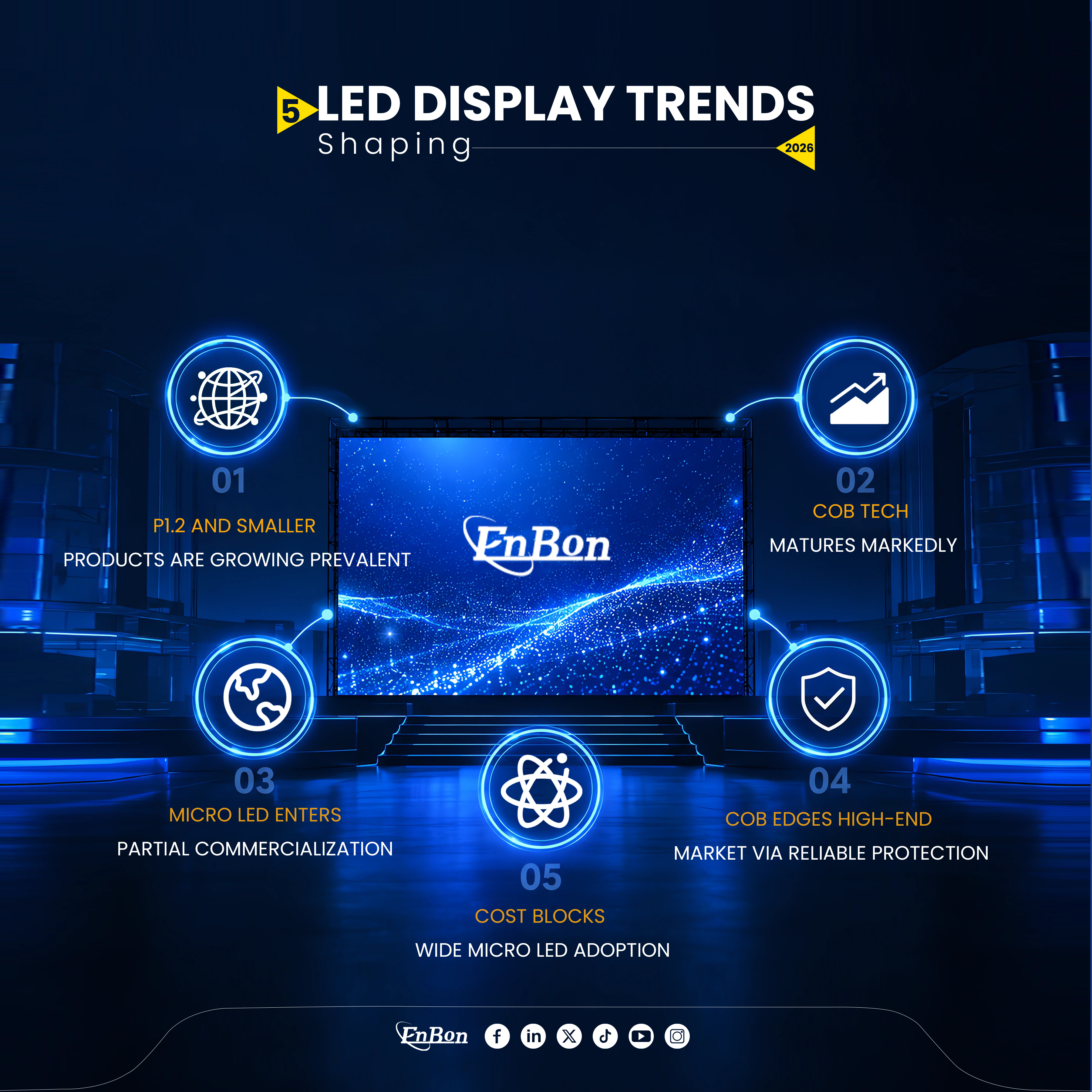
1. Products with a pixel pitch of P1.2 or finer are becoming increasingly common.
2. COB (Chip-on-Board) packaging technology has matured significantly.
3. Micro LED is transitioning from the conceptual stage to initial commercialization.
However, it is important to note:
4. Cost remains the primary factor limiting the mass adoption of Micro LED.
5. COB’s advantages in reliability and durability make it highly competitive in the high-end market.
Trend outlook:
A "three-tiered structure" will emerge in the near future:
1. Low-to-mid-end: SMD remains the mainstream technology.
2. Mid-to-high-end: COB is rapidly gaining market share.
3. High-end and future: Micro LED is gradually being implemented.
III. Lightweight design and structural innovation as core competitive advantages
Driven by the growth of the rental market and the need for rapid deployment, structural design has become increasingly critical:
1. Carbon fiber cabinets are entering the market (reducing weight by 30%–60%).
2. Quick-lock mechanisms and modular structures are becoming standard features.
3. Ultra-thin cabinets (under 70mm) are becoming increasingly common.
A fundamental shift: The focus has moved from competing on "specifications" to competing on "user experience"—with transportation efficiency, installation speed, and labor costs becoming key decision-making factors. IV. Global Supply Chains Shift Toward "Regionalization and Resilience"
Driven by geopolitical factors and transportation volatility over the past few years, the LED industry supply chain is undergoing structural changes:
1. Companies are establishing multi-regional warehousing and service networks.
2. The supply of core components (ICs, LED beads) is becoming more diversified.
3. Localized teams and distribution networks are gaining importance.
Trend Summary: "Lowest cost" is no longer the sole objective; "stable delivery capability" has emerged as a new core competitive advantage.
V. Convergence of Content and Display: Entering the "Experience-Driven" Era
The era of simply selling screens is ending, and the value of content is being further amplified:
1. Demand for naked-eye 3D content production is surging.
2. XR virtual production is driving demand for screens with high refresh rates and high grayscale performance.
3. Commercial spaces are placing greater emphasis on "visual marketing" impact.
Industry Shift: LED companies are transforming into providers of "hardware + content + solutions" rather than mere equipment suppliers.
VI. Price Competition Eases; Value-Based Competition Intensifies
While market competition remains fierce, the marginal returns of pure price wars are diminishing:
1. Customers are increasingly focused on long-term stability and maintenance costs.
2. Brand reputation and service capabilities have become key decision-making factors.
3. Profit margins in the high-end market remain relatively stable.
Core Shift: Moving from "who is cheaper" to "who is more reliable and efficient."
Conclusion: The Industry Enters a Phase of "Refined Competition"
By 2026, the LED display market will have moved beyond its early stage of rapid expansion into a phase characterized by:
1. Continuous technological evolution.
2. Increasing application segmentation.
3. More rational competition.
Future success will not hinge on a single advantage but on a contest of comprehensive capabilities: product strength + delivery capability + localized service + content ecosystem.
If you operate in the LED industry, this wave of change is critical. Simply put: the era of hardware competition isn't over, but competing on hardware alone is no longer enough.